
Why weighting makes your employee survey scores fairer
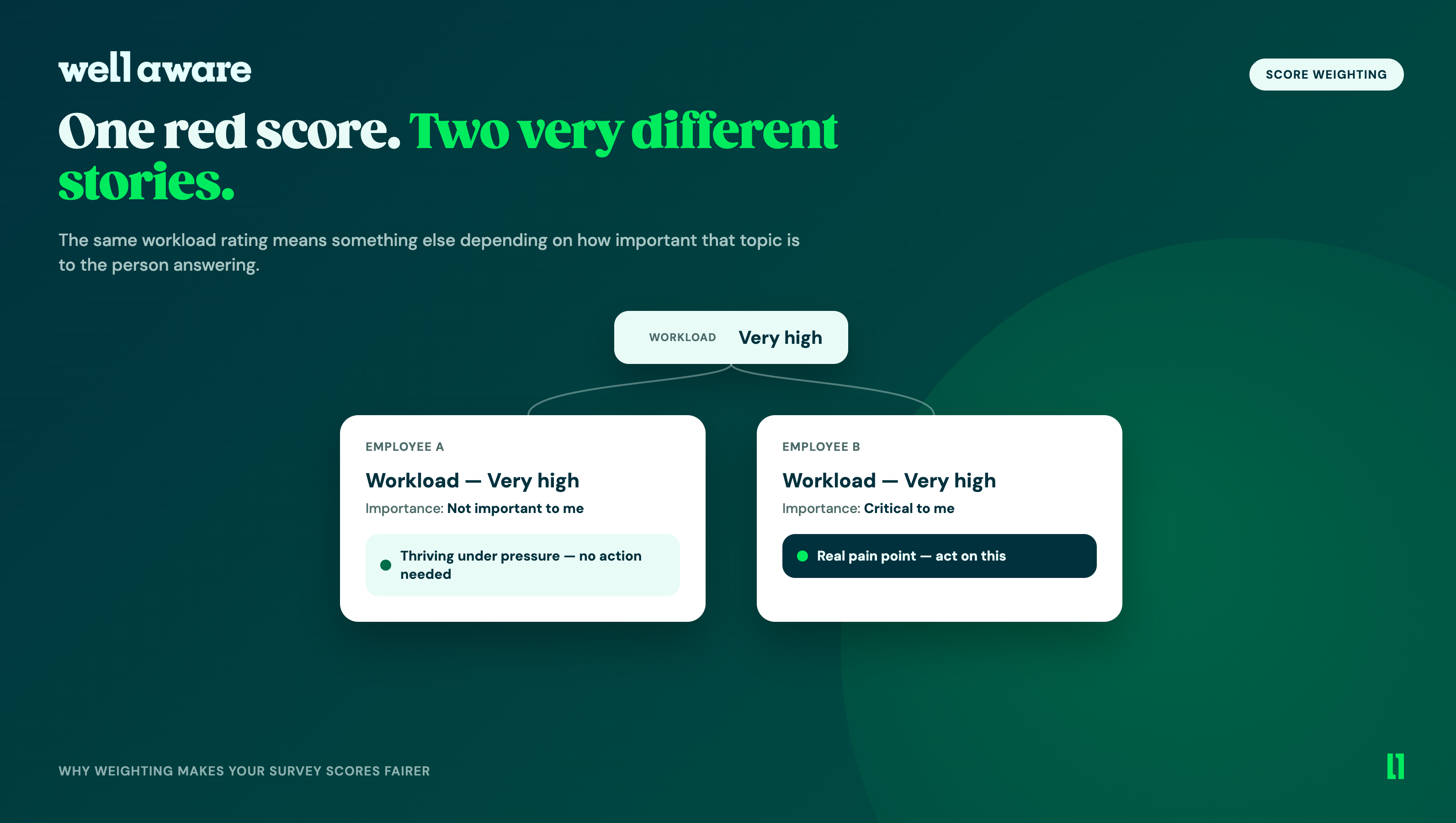
Your employee survey results are in. You scroll through the dashboard and there it is: workload, bright red. Panic sets in. Time for an action plan, extra headcount, maybe even a reorganisation.
But hold on. What if that high workload isn't a problem for half your team at all? For some people, a busy stretch is exactly what gets them going. They thrive under pressure. For others, that same workload leads to stress, burnout, and eventually people leaving. One score, two completely different stories. That's exactly why weighting your employee survey matters.
What is weighting, exactly?
Weighting means employees don't just answer a question, they also tell you how important that topic is to them. Alongside the score, they get room to share an opinion and a comment.
So it's not just "how do you experience your workload," but also "how important is this topic to you." Ideally, with space to explain it in their own words too.
That extra bit of context is the difference between a score you have to guess at and a score you actually understand.
The workload example
Take workload, the classic red flag in every employee survey. Without weighting, high workload almost automatically turns the score red. That makes sense, because the question only measures intensity, not what that intensity means to the person answering.
With weighting, you see more straight away. Someone who reports high workload but doesn't rate the topic as important is sending a very different signal than someone who gives the same score and calls it critical. That second person is telling you: this is a real pain point. The first is telling you: this comes with the role, and I'm handling it fine.
Without those two pieces side by side, you lump both responses together. With weighting, you don't.
Without weighting: everything's red, nothing's clear
An employee survey without weighting works like a smoke alarm that goes off every time you make toast. There's a signal, but you don't know whether to grab the extinguisher or just keep eating.
That's the problem with unweighted scores: high workload defaults to red, whether it actually hurts or not. Your HR team ends up acting on a signal that isn't accurate for part of your workforce. Time, budget, and attention flow toward the wrong problem, while the real pain point stays hidden.
Why this checks out, scientifically too
This lines up directly with the Job Demands-Resources model (JD-R), the scientific foundation behind Well Aware's survey methodology, developed by Prof. Dr. Wilmar Schaufeli. The model shows that workload isn't inherently good or bad. It's a job demand, and whether that demand feels like a burden or a challenge depends on personal factors and the balance with the resources someone has.
In other words, the same workload can be a resource for one person and a stressor for another. A survey that doesn't capture that difference is missing a core piece of the science it's supposed to be built on.
What weighting gets you as HR
Weighting turns your employee survey from a list of red flags into a tool that actually shows you where the pain is. That gets you a few things.
You can separate noise from signal. Not every red score needs action, and now you actually know that instead of having to guess. Your action plans get sharper, because you can see which topics genuinely matter to your people. And your employees feel taken more seriously, because they could do more than just give a number, they could tell you what matters to them and why.
That last part might be the most important one. An employee survey is, at its core, a conversation. Weighting makes sure it actually feels like one, instead of a mandatory list of statements.
Get started
Red scores without context lead to the wrong action plans and missed pain points. Want to see how weighting works inside a continuous, science-backed employee survey? Check out Well Aware's employee survey and go further than just a number.

.jpg)

.jpg)
.jpg)
.jpg)



Time for action
Book a demo free of obligations and see for yourself how your team really feels.
Book a Demo