
Preventive health checks explained: what you have to do, what you can do, and why it matters
"Do we actually have to do a PMO?" HR managers ask us this a lot. PMO is the Dutch abbreviation for a preventive medical examination, and the honest answer is shorter than most people expect: no, you have to offer one. That's not the same thing. And that difference is exactly where the room is to turn it into something worthwhile.
What is a PMO?
A PMO is a periodic check on how your employees' health is doing, ideally before problems show up rather than after. Employees get insight into their own health and advice on what to do with it. As an employer, you get an anonymised picture of what's going on across the group.
You'll also come across the term PAGO, the periodic occupational health examination. People often use the two interchangeably, but there is a difference. The PAGO looks specifically at health risks that come from the work itself, like noise, dust, heavy lifting or workload. The PMO is broader and also covers lifestyle and general health. Many organisations combine the two: one PMO with the PAGO built in.
Is it mandatory?
Article 18 of the Dutch Working Conditions Act (Arbowet) says employers must periodically give employees the opportunity to undergo an occupational health examination. That's about it. The law says surprisingly little about what that examination should look like.
A few things are clear, though:
- Offering it is mandatory, taking part is not. Each employee decides for themselves.
- What it covers depends on the risks in your organisation, as identified in your risk assessment (RI&E).
- The medical part falls under the responsibility of an occupational physician, who also advises on how often to repeat it.
- Some roles come with extra rules, for example when working with hazardous substances, high noise levels or night shifts.
Beyond that, what you offer and how extensive it is is up to you.
What does a PMO look like?
Because the law prescribes so little, a PMO can look quite different from one organisation to the next. Roughly speaking, there are three layers you can offer on their own or together.
A questionnaire
The foundation, and for many organisations the whole PMO. Employees answer questions about how they feel physically and mentally, about workload, stress and how they experience their work, and about lifestyle: sleep, exercise, diet, alcohol and smoking. This is the 'light' version you see a lot. Easy to take part in and easy to scale.
A physical check
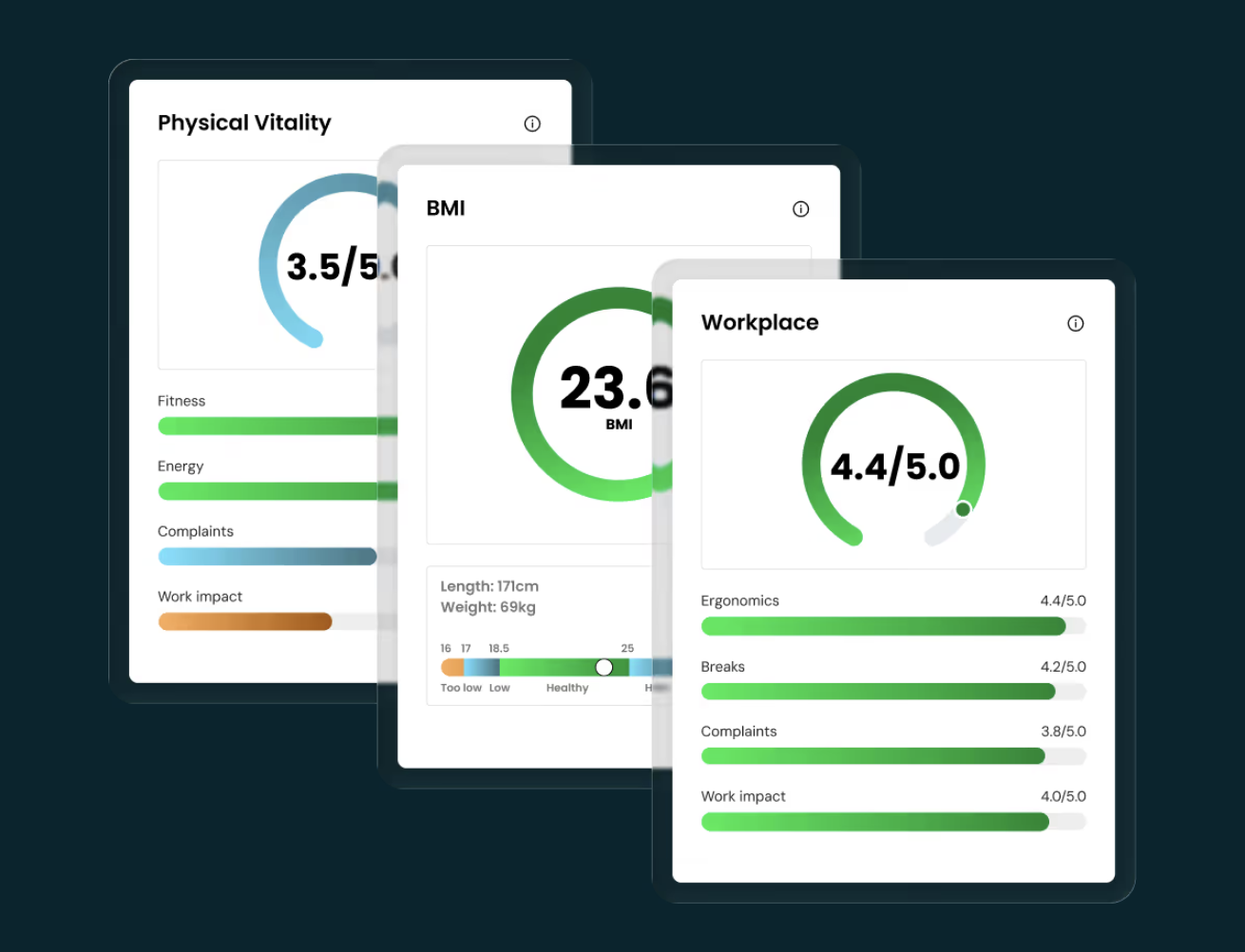
If you want to go further, you add a physical examination. Think blood pressure, heart rate and BMI, sometimes with a fitness test or a hearing and eyesight check. Many employers see this mainly as an extra service for their people.
Job-specific tests
Roles with specific risks get targeted tests on top. A lung function test for people working with dust, a lifting and movement analysis for physically demanding jobs, or stress and recovery measurements where the mental load is high.
Afterwards, each employee receives a personal report with recommendations. The employer only sees an anonymised group report, never individual results. That isn't just how it's arranged, it's also the only way people will answer honestly.
Is an ePMO enough?
An ePMO is a PMO that runs entirely online, through a digital questionnaire. Many employers wonder whether that's enough, or whether someone with a blood pressure monitor still needs to come by.
For most organisations, an ePMO is enough. Nowhere does the law require physical measurements. What counts is that you offer employees an examination that matches the risks in their work. In office jobs and most service roles, those risks are mainly about workload, stress, recovery and how people experience their work. A good questionnaire is actually the best way to map those.
So physical testing is optional. You're free to offer it as an extra service for your people, but you don't have to. Only roles with specific physical risks, like working with dust, hazardous substances or high noise levels, call for targeted medical tests. Whether that applies to your organisation follows from your RI&E.
Well Aware's ePMO is that kind of digital approach, based on the Job Demands-Resources model. Anyone with a medical question after the questionnaire can turn to an occupational physician. And if an organisation does want to add physical measurements, we arrange that through our own occupational physicians or our network of occupational health services.
Why bother?
Because it's about your people. A PMO exists to support employees individually. Someone finds out their blood pressure is on the high side, that they've been sleeping badly for months, or that their workload has felt too heavy for a long time. You'd rather know that now than a year from now, when someone is off sick.
It helps to put the PMO next to your risk assessment. The RI&E looks at the organisation: what risks are built into the work, and what policy do you have for them. The PMO looks at the person. Use the group results of your PMO as input for your RI&E and you're working on both levels at once. You see what people are running into, and you can turn that into measures for teams or the whole organisation.
Where it often goes wrong
The examination itself is rarely the problem. What comes after is. An employee gets a report telling them to move more and sleep better, and that's where it ends. The employer gets a group report that disappears into a folder. Three years later, the next PMO comes around.
So think about the follow-up before you start. What can an employee do if something comes up? Who can they turn to? And what will you do as an organisation with the patterns you see?
How we approach it at Well Aware
For us, a PMO isn't a one-off moment every few years. It fits into what we already do: listening to employees continuously and actually doing something with what they tell us.
Employees fill in short check-ins through channels they already use, like WhatsApp, Teams or email, with no account or app needed. The questions are based on the Job Demands-Resources model developed by Prof. Dr. Wilmar Schaufeli, co-founder of Well Aware. They're about what drains energy and what gives it, at work and outside it. That covers the questionnaire part of the PMO and the psychosocial part of the RI&E in one go, without people getting three different surveys in their inbox.
The difference is in what happens next. Employees see their own results straight away, with a concrete action point. If someone wants to talk to a professional, they can book a session with a psychologist, coach or other specialist from within the platform, usually within 24 hours. Managers see an anonymous picture of their team, with practical pointers for the team conversation. HR sees the patterns across the organisation and feeds them into the RI&E and prevention policy. For the medical part, we work with occupational physicians, both our own and through our network of occupational health services.
Privacy isn't an afterthought. Insights only become visible from five respondents per team, no one can be traced back, and all data stays within the EU.
That way the PMO stops being a box you tick and becomes the start of support that keeps going. Even after the test.
Wondering how a PMO fits alongside your engagement survey and risk assessment? Take a look at Well Aware's PMO or get in touch, we're happy to think it through with you.

.jpg)

.jpg)
.jpg)
.jpg)



Time for action
Book a demo free of obligations and see for yourself how your team really feels.
Book a Demo