
The science behind Well Aware
Know what is happening, before things go wrong.
Every question, dashboard, and action is based on the JD-R model by Prof. Dr. Wilmar Schaufeli, co-founder of Well Aware. On top of that, we build on the science of how people become aware of what is happening.
1
Reflect
Everyone has a voice
2
Awareness
Insight into what is happening
3
Action
Direct support from specialists
Continuous
not just once a year
JD-R
The world's most widely used model for employee experience
60,000+
Employees measured, across 24 countries
22
Countries in the benchmark, recalibrated every two years
80%+
Average response rate to pulse surveys
First awareness, then action
Help only works when people know they need it.
That is why we combine pulse data and AI feedback with direct access to specialists, ensuring that warning signs become visible in time. Each cycle of the method moves a team one phase further.
Phase 1
Reflect
Unconsciously incompetent
You don't know what you don't know. Warning signs are missed and problems come as a surprise.
About 95% of people are still in this phase. Only a few make it further.
Phase 2
Awareness
Consciously incompetent
You see what is going on. Problems are identified and categorised: which team, which theme, and how urgent.
Phase 3
Action
Consciously competent
You act in time. Warning signs are addressed before they lead to absenteeism.
With Well Aware, a psychologist or coach is booked within 24 hours.
Phase 4
The result
Unconsciously competent
Well-being is embedded in how the organisation operates. Conversations happen naturally and results are sustained without the need for a programme.
Why this works
You only take action once you are aware of the obstacles you are facing. That is why people often sound the alarm too late, even though many others saw it coming. By making more people aware at an early stage, more people can grow and recover faster. The model is based on learning psychology (Noel Burch, 1970s).
The Well Aware Method
Any tool can measure. But does it lead to action?
There are over a thousand options for just measuring or a quick fix. Real impact requires that measurement, insight, and action are connected. At Well Aware, that is all in one place.
What you usually get (1000+ options)

Measuring only
A survey provides numbers. Then, everything goes quiet.
A quick fix
A training course or an app addresses a symptom without knowing what is actually going on.
What Well Aware does
Measurement, insight, and action in one place
Every round builds on the last. This is how measuring truly leads to action.
Step 1
Reflect
Everyone has a voice
- Pulse surveys via WhatsApp, Teams, Slack, or email
- Anonymous: insights only available for teams of 5 or more respondents
- Unlimited custom questions in addition to the JD-R baseline
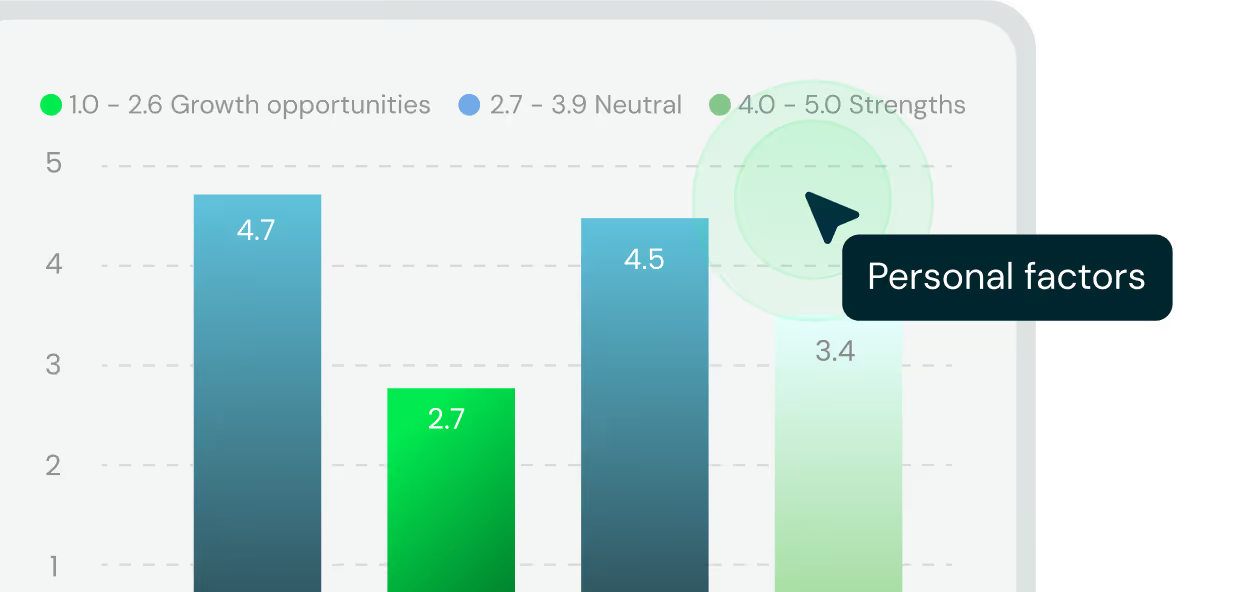
Step 2
Awareness
Feedback and real-time dashboards
- Dashboards for HR, managers, and leadership
- Well-AI recognises patterns and early risk signals
- Benchmark by country and sector

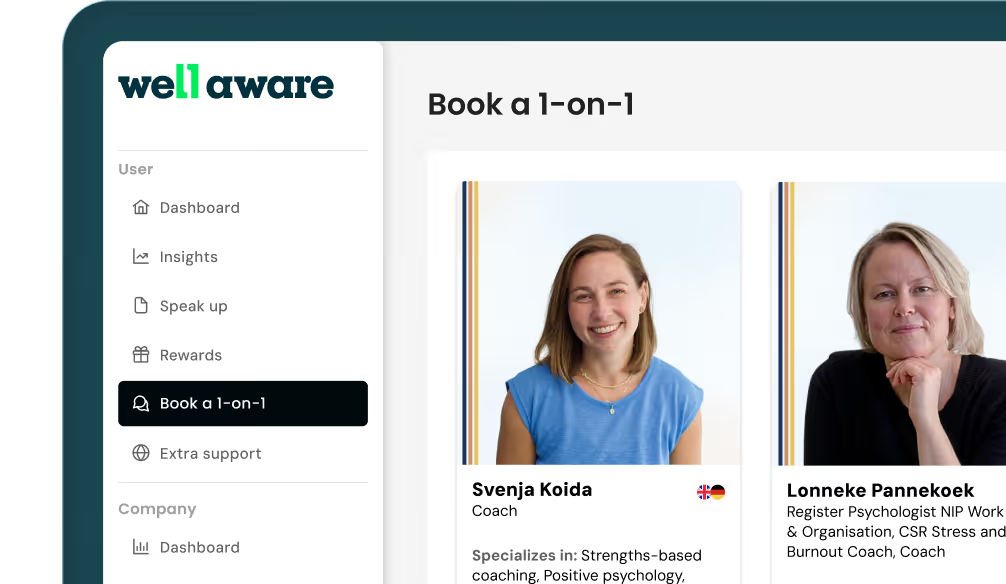
Step 3
Action
Action items and direct support
- Concrete action items and conversation starters for every signal
- Psychologists, coaches, and confidential advisors
- 100+ training courses and workshops for teams and leaders
The cycle runs continuously, not just once a year.
Scientific foundation
Built on the JD-R model.
The Job Demands-Resources model explains how work either energises or drains people. It divides working conditions into energy resources and stressors. Leadership and personal factors determine how these two affect an individual.
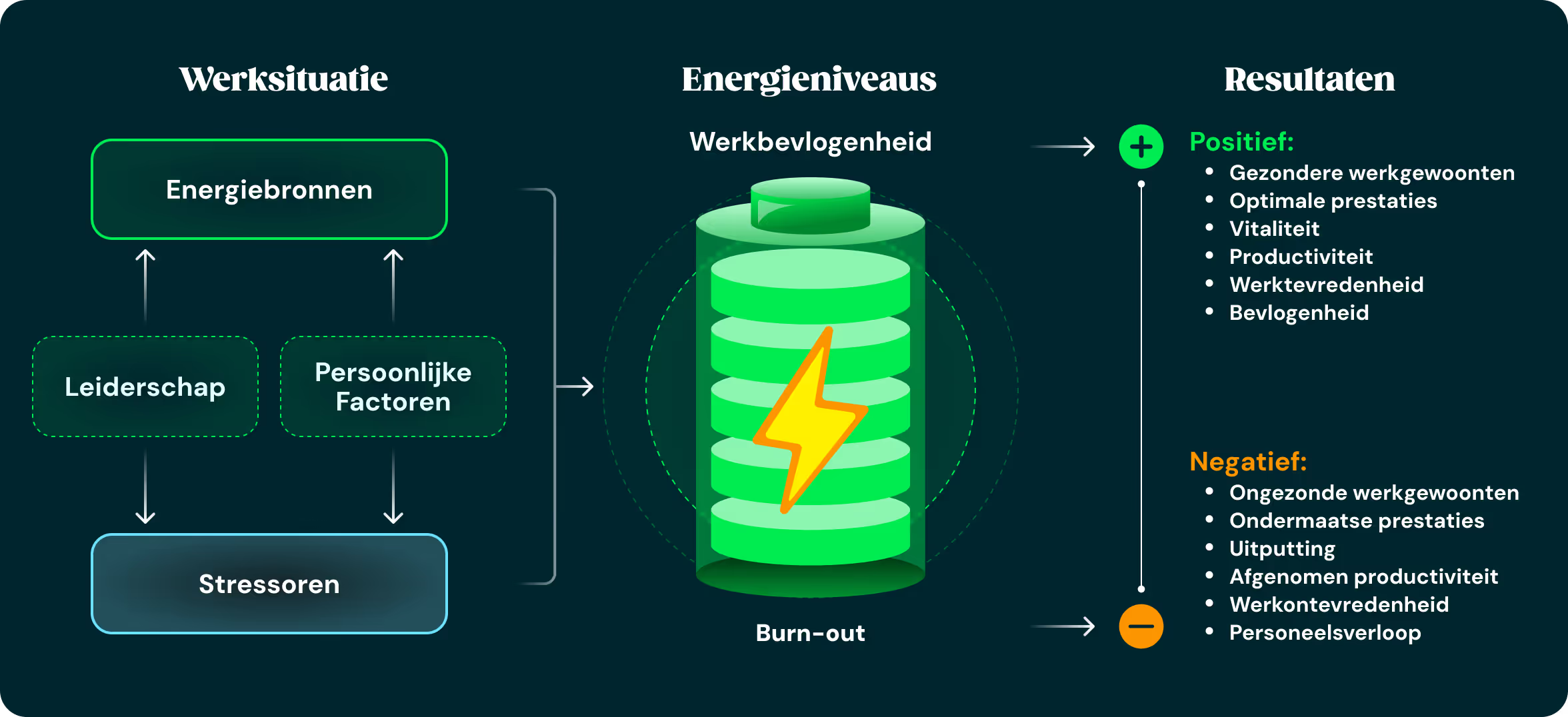
Work situation

Energy levels
Work engagement
Burnout
Results
Positive
- Healthier work habits
- Optimal performance
- Vitality
- Productivity
- Job satisfaction
- Engagement
Negative
- Unhealthy work habits
- Underperformance
- Exhaustion
- Decreased productivity
- Job dissatisfaction
- Staff turnover

“Well-being at work is not a snapshot. If you measure continuously and in the right way, you can see it growing or declining long before someone burns out.”
Prof. Wilmar Schaufeli, PhD
Founder of the JD-R model, co-founder of Well Aware
Developed with insights from leading universities




Measurement model
Which themes do we measure?
The standard questionnaire is linked to the scientific benchmark. You can add your own questions without limit, without compromising validity.
Boosts energy
Energy boosters
- Autonomy
- Appreciation
- Support
- Meaningful work
- Growth
Drains energy
Energy drainers
- Workload
- Time pressure
- Uncertainty
- Work-life balance
The benefits
Well-being
- Engagement
- Health
- Burnout signals
- Sleep
Your buffer
Personal resources
- Resilience
- Recovery capacity
- Setting boundaries
From employee surveys to risk assessments, all in one platform.
No need for a separate supplier for every survey. Well Aware brings them together in one continuous questionnaire, with the same scientific basis.
MTO
Employee satisfaction. The annual foundation, now continuous.
→
PMO
Preventive medical examination. Mapping health and work capacity.
→
PSA
Psychosocial workload. Work pressure, undesirable behaviour, and work-related stress.
→
RI&E
Risk assessment and evaluation. Legally required, mapping workplace risks.
→
Culture
Culture scan. How people truly experience the organisation and collaboration.
→
eNPS
Employee Net Promoter Score. Would employees recommend you as an employer?
→
Continuous validation
Science that evolves with you.
The benchmark is re-validated every two years, by country and by sector, based on tens of thousands of respondents. This means that what you measure today is compared against a current standard.
Well-AI runs on self-hosted open-source models within the EU. Data never leaves Europe and is never used to train external models.
150+
HR teams measuring with Well Aware
22
Countries in the benchmark
2 years
Between two benchmark recalibrations
80%+
Average response rate to pulse surveys
Secure and GDPR-compliant






Curious what this means for your organisation?
In a demo, we show how Well Aware measures, flags, and helps you take timely action, based on the JD-R model.
Book a Demo